Werkzeug Tool
Werkzeug Tool
Turning retooling complexity into operational clarity
Industry
Pharmaceutical
Role
Lead UI/UX Designer
Timeline
May 25 - Sept 25
Product type
Digital workflow platform
Industry
Pharmaceutical
Role
Lead UI/UX Designer
Timeline
May 25 - Sept 25
Product type
Digital workflow platform
OBJECTIVE
OBJECTIVE
Defining a modern workflow for pharma machine and tool management
Defining a modern workflow for pharma machine and tool management
The Werkzeug Tool is a pharma production asset-management concept designed to support the planning and coordination of machines, tools, and retooling workflows in a highly structured operational environment. Developed by an in-house engineering team with deep production experience in the German pharmaceutical industry, the product was meant to be pitch-ready and easy to communicate to potential stakeholders and customers. The challenge was to translate a technically dense and highly operational process into a clear and convincing product experience that could be used for presentations and sales conversations. For me as the UX lead, that meant not only designing the interface, but also shaping the underlying logic in a way that made the workflow understandable, visually accessible, and grounded in real production constraints.
The Werkzeug Tool is a pharma production asset-management concept designed to support the planning and coordination of machines, tools, and retooling workflows in a highly structured operational environment. Developed by an in-house engineering team with deep production experience in the German pharmaceutical industry, the product was meant to be pitch-ready and easy to communicate to potential stakeholders and customers. The challenge was to translate a technically dense and highly operational process into a clear and convincing product experience that could be used for presentations and sales conversations. For me as the UX lead, that meant not only designing the interface, but also shaping the underlying logic in a way that made the workflow understandable, visually accessible, and grounded in real production constraints.


APPROACH
APPROACH
Focusing on the core user flow
Focusing on the core user flow
Focusing on the core user flow
The overall approach and design process were centered on quickly identifying the primary user flow and shaping it in a way that could support both clarity and sales communication. In this case, that meant focusing early on the Rüstauftrag flow as the core interaction pattern and exploring it through different visual and structural representations to show the product from multiple angles. The goal was not just to make the workflow understandable, but to illustrate it in a way that felt credible, presentable, and strong enough to support stakeholder discussions from the very beginning. By concentrating on the main flow first, the team was able to define the product direction more efficiently and communicate the value of the tool in a highly accessible way.
The overall approach and design process were centered on quickly identifying the primary user flow and shaping it in a way that could support both clarity and sales communication. In this case, that meant focusing early on the Rüstauftrag flow as the core interaction pattern and exploring it through different visual and structural representations to show the product from multiple angles. The goal was not just to make the workflow understandable, but to illustrate it in a way that felt credible, presentable, and strong enough to support stakeholder discussions from the very beginning. By concentrating on the main flow first, the team was able to define the product direction more efficiently and communicate the value of the tool in a highly accessible way.

SOLUTION
SOLUTION
Creating clarity around the main "retooling-journey"
Creating clarity around the main "retooling-journey"
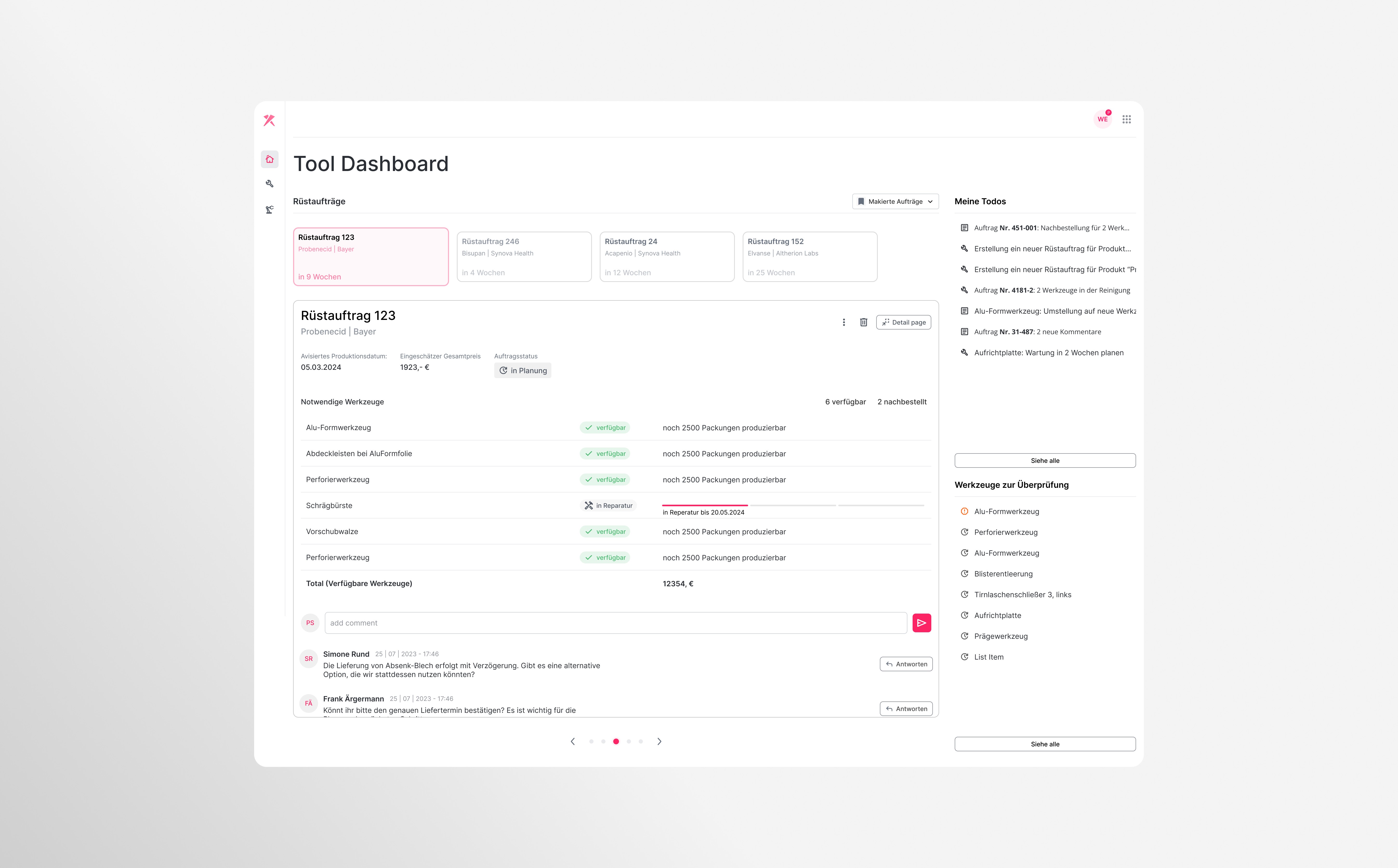
The solution was to turn the retoolingprocess into a clear, structured, and visually accessible workflow that could support both operational decision-making and sales conversations. By combining a high-level overview with detailed tool and machine information, the interface made it easy to identify the right setup, check availability, understand status and capacity, and assign an order number with confidence. Rather than presenting the process as a purely technical sequence, the design made the main flow tangible through high-fidelity UI, data-driven layouts, and a strong visual hierarchy that helped communicate feasibility, clarity, and product value early on.
The solution was to turn the retoolingprocess into a clear, structured, and visually accessible workflow that could support both operational decision-making and sales conversations. By combining a high-level overview with detailed tool and machine information, the interface made it easy to identify the right setup, check availability, understand status and capacity, and assign an order number with confidence. Rather than presenting the process as a purely technical sequence, the design made the main flow tangible through high-fidelity UI, data-driven layouts, and a strong visual hierarchy that helped communicate feasibility, clarity, and product value early on.

REFLETION
REFLETION